Fast Lane or Pit Stop? 🏎️💨


Should You Use Azure OpenAI Realtime API — and When to Hit the Brakes
TL;DR: A 300 ms voice‑round‑trip feels like magic, but magic carries a bill. Before you refactor your chatbot into a pit‑crew radio, read this guide to see when Realtime is worth the upgrade, when classic /chat is the wiser lane, and how to decide in < 10 minutes.
1 · The Decision Matrix: Green‑Flag vs Red‑Flag Scenarios
| Use Realtime API (Green Flag) | Stick with /chat completions (Red Flag) |
|---|---|
| Live voice assistants, IVR, in‑call agent copilots that must interrupt gracefully | Batch Q&A, report generation, nightly summaries where latency >2 s is fine |
| Multimodal kiosks (cars, hospital check‑ins) where speech is primary UI | Workflows already bound to text channels (Slack, email) |
| Live translation where audio & text race in parallel | Projects in regions outside East US 2 & Sweden Central (adds >150 ms RTT) |
| Accessibility features needing barge‑in & partial transcripts | Enterprises with strict UDP‑blocked networks & complex firewall reviews |
Next up: we’re about to dissect five hidden costs that might flip your decision back to /chat.
2 · Five Reasons Not to Use Realtime (Yet)
- Preview SLA 🛑 — Downtime can spike to minutes with zero notice. If a 30‑second outage hurts revenue, keep
/chatas primary. - Region Constraint 🌍 — Only two Azure regions today. Cross‑ocean latency offsets the gain; test from your user base before committing.
- Cost Multiplier 💸 — You pay for audio‑seconds + tokens. For a 90‑second dialog, Realtime can cost ~3× classic chat. See cost calc below.
- Firewall Friction 🔒 — WebRTC over UDP 10000‑20000 is blocked in many corporate networks. TURN over 443 rescues it but doubles RTT.
- Complex Observability 📊 — You now monitor three legs (transcribe, infer, synth) instead of one
/chatcall. More spans, more alerts.
Next: we’ll put numbers on cost vs performance so you can justify (or veto) the upgrade in your design review.
3 · Hybrid Playbook: The Best of Both Worlds
When neither a full 300 ms voice round‑trip nor a bargain‑basement bill alone is good enough, run both engines:
| Phase | Why Use Realtime? | When to Downgrade to /chat |
|---|---|---|
| Greeting (≤ 30 s) | Natural wake‑word, zero‑lag “How can I help?” feels human. | After user intent is clear and latency stops affecting trust. |
| Clarification Q&A (30 – 90 s) | Rapid back‑and‑forth keeps the dialog fluid. | Once context stabilises and user expects a longer answer. |
| Long answer / summary | — | Stream text via /chat, then TTS locally or with /audio/speech. |
| Idle or hold | — | Suspend Realtime WebRTC to stop paying for empty audio seconds. |
Implementation tips
- Dynamic router — If
dialogState.turns < 6andavgUserUtteranceSec < 5, keep Realtime; else switch. - Single transcript source of truth — Store partial ASR results in the same vector store your
/chatmodel uses so you can swap seamlessly. - Budget guardrail — Abort Realtime when estimated session cost exceeds the set $$$ budget.
Net result: Users get snappy voice interaction where it matters, and finance still gets predictable token‑based spend.
4· Cost per Token: Visual Proof
| Model | Raw token price* | All‑in cost / token** | Multiplier vs /chat |
|---|---|---|---|
| /chat | $0.01 / 1 K | $0.000 01 | 1× |
| Realtime | $0.01 / 1 K | $0.000 03 | 3× |
* GPT‑4o preview pricing (July 2025).
** Example 300‑token, 90‑second dialog: $0.003 tokens + $0.006 audio = $0.009 total ⇒ $0.00003 / token.
Takeaway: Realtime’s headline token rate may match /chat, but once you amortise audio seconds, each token effectively costs about three times more.
5 · Mini Case Study: Cost vs Latency
| Metric | /chat | /realtime |
|---|---|---|
| Median RTT | ~1 800 ms | ~290 ms |
| Tokens billed (150 × 2‑turn dialog) | 300 tokens | 300 tokens |
| Audio seconds billed | 0 | 90 sec |
| Azure region egress | Text only | +Opus audio both ways |
| Estimated bill* | $0.002 | $0.006 |
* Example pricing June 2025, GPT‑4o (preview). Audio charged at $0.004 / min; tokens at $0.01 / 1 K.
Verdict: if shaving ~1.5 s is mission‑critical and your session lasts < 60 s, pay the premium. Otherwise bank the savings.
Still here? Let’s see how to mitigate each downside if you need that 300 ms thrill.
6 · Mitigations: Making Realtime Production‑Safe
| Risk | Mitigation |
|---|---|
| Preview SLA | Feature flag Realtime; fallback to /chat if 3 × timeout or 5XX in 30 s window. |
| Region limits | Deploy static edge (CDN) near users; CONNECT from browser directly to region to avoid double hops. |
| Cost creep | Summarise long bot replies and switch to /audio/speech TTS after 2 sentences. |
| Firewall | Autodetect ICE failure → upgrade to TURN/TCP 443; pre‑flight call to speed TURN allocation. |
| Observability | Emit OpenTelemetry spans: transcribe, infer, synth; sample 1 % traffic for waveform logs. |
Conclusion
Realtime is race‑car fast but sports‑car expensive and still a preview. Use this guide to decide whether to floor the pedal or cruise. Whatever lane you choose, the reference repo gives you the steering wheel.
Wouldn’t mind a detour learn more about the Realtime API?
Related Posts
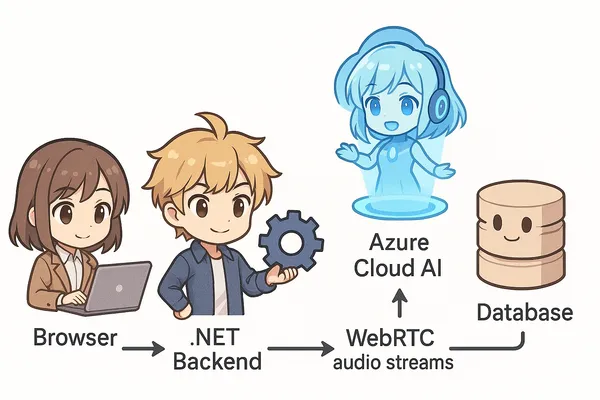
Azure OpenAI Realtime API w/ a .NET + React
What if your AI side-kick could answer *before* you finish talking?
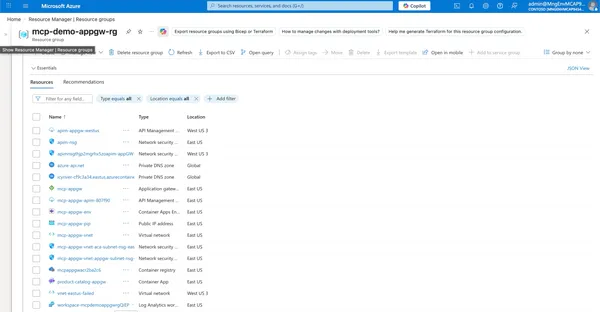
Enterprise-Grade MCP Servers: App Gateway + Internal APIM + Container Apps
How to deploy an MCP server behind three security layers — with zero public API endpoints, WAF protection, and full network isolation.
Securing Your MCP Servers with Azure API Management and Entra ID
How to add OAuth 2.0 authentication and role-based authorization to MCP servers — so your AI tools only do what users are allowed to do.